16th Sunday of Year C


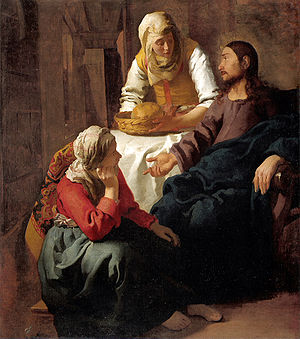
Martha and Mary
 

 It is interesting to note how brothers and sisters in a family can be similar in appearance and be readily identifiable from their parents; yet how they differ! People might express surprise when they find out you are a brother or sister to someone they know well, and suddenly make the connection with you. They might say ‘you are not a bit alike’!

 It is interesting to note how personalities and tastes and temperaments differ under the same roof. How some people can be described as ‘explorers’ (adventurous, wanting to socialize at parties, see the world) and those who are ‘settlers’ (I’d rather stay at home, order a take-out, watch a movie on TV). [They usually marry each other!]

 Comparisons are odious. We hate the phrase as we grow up: ‘why can’t you be more like your brother/sister?’ At school, if you had an older brother or sister, teachers may, intentionally or not, compare you (usually unfairly) with an older sibling, and expect you to measure up to their abilities or achievements. You are not seen for who you are as a unique individual with your own quirks. You may feel constricted, in a strait-jacket by this measure.

All our lives we will be compared one way or the other. We have to accept that and work on our own uniqueness! One of my favourite books is ‘The temperament God gave you’ and you learn to accept certain things about yourself and other’s points of view or alternative ways of seeing things and acting. People will have to accept us too!

Martha and Mary are presented to us as different contrasting personalities. Martha is the active, about -the-house type, expresses her opinions readily, complains, sees all that there has to be done and stresses about it. Mary is silent, recollected, seemingly passive, a listener. Martha complains that Mary should be helping. Jesus rather, praises Mary for getting her priorities right, for ‘choosing the better part’. Martha, it seems, had lost sight of the bigger picture. She focused more on the WHAT of life than the WHY. Martha had lists of things to be done and would mentally cross them off, Mary had one thing on her mind: ‘today the Lord and Master is coming to visit; I will listen and learn and keep Him company’. Whereas Martha was concerned about short-term soon-to-forgotten priorities and jobs to fill her day, Mary achieved more because she has her eternal end in sight and acted on that perspective.

I have always had one difficulty with this story though. It seems unfair! Martha was trying to do her best after all! I remember growing up that if guests came to visit, that we would all be expected to help out in the kitchen to get things ready or set the table or clean around the house. We would be quickly reminded to help out and to do our share of the work if we were seen to be slacking.

 
Maybe the problem though is that Martha did not know when to stop. The unique opportunity of having Jesus as her guest was lost sight of. She kept on working and would lose the meaning of the present moment. How often we lose sight of what we are doing at a given moment because we are too focused on ‘what’s next’? We need more recollection and repose, like Mary, who chose the better part’.

We need more interior life.


Fifteenth Sunday of the Year


The Good Samaritan


In recent weeks and days we have seen the importance of decision making, the pain and the torture and the sleepless nights some people in our Government and backbenches have experienced in coming to a final decision, a decision that will affect countless thousands of women and their unborn children in the years to come.

I do not wish to dwell on the outcome of this week. That is for another day. But some of what follows could be applied now to how we address the topic of the unborn from now on.

What the readings for the Gospel tells us is the importance of coming to the right decision and the part that flawed reasoning takes that we can infer from the Levite and the priest on their way to worship.

As we might reflect on the decisions of various public representatives, it is strangely appropriate that the parable presented to us today is in fact about coming to a right way of thinking and acting out of that conviction.

The stained glass window on the left hand side of the cathedral or the north side, three windows down, shows clearly in summary the Good Samaritan and behind him one turning to the left and the other to the right, the priest and the Levite going their separate ways.

The two baddies in the story were those who purportedly worshipped God and were on their way to do so and as we know so well, ignored the pressing urgent need before them that should have taken priority. Their reasoning was based on human regulations of what was clean and unclean. They categorised the person before them and turned away.

Their false sense of what was right, their narrow focus on uncleanness and thereby were losing sight of the God they worshipped. They made a deliberate decision by their body language and movement – no words of theirs are recorded. Theirs was silent inaction and avoidance of what and who was put before them. The poor person who was violated has his dignity violated again by two acts of deliberate avoidance. The Levite and priest are so heavenly-minded that they are of no earthly use. They have also sinned against themselves as well as giving dishonour to the esteem others have accorded to their chosen profession /way of life. It must have been quite shocking to Jesus’ hearers that He would have used the analogy without of course naming and shaming any named individual or group before him.

In the course of our day, certain unexpected situations will crop up – each challenging us to react and decide, a phone call and the caller ID makes us decide whether we are going to bother, the neighbour or fellow parishioner who hasn’t spotted the fact that we have seen them first and we dive into a shop or cross the road rather than face a tedious and time consuming conversation, someone we want to avoid, in a coffee shop or restaurant, we don’t want to be caught. Where we sit in a train or a bus or an airplane, glad to avoid discomfort and avoiding someone we find boring or a pain to listen to! Even, dare I say it, where we sit in church in order not to be seen by others!? We can all think of a person who might take up our valuable time and who never usually show any real interest in us, who are better at talking than listening.

We are glad we avoided them and saved ourselves a tedious situation

And how much they might actually need someone to talk to and we have left the opportunity pass us by?

We might purposely avoid that street corner or bridge in the city where a beggar with a cup might be perched.

It can be hard when people we know deliberately ignore us.  And we are all guilty of avoiding others. But rather than dwelling on my hurt, have I done the same thing, where the first person to nab me as it were keeps me from meeting the people I would prefer to meet?

I suppose we have to allow everyone a bad day now and again and make allowances but we can really hurt people by ignoring them – adding insult to injury to the poor man was beaten up in the story was passed by and who could, we imagine, perhaps hear the footsteps of potential help fade away in the distance.

Finally, it is also a case of procrastinating. Maybe the priest and Levite decided to wait and return. Who knows? After all it is only a story but we are delving in to their motives, because we can see times when we delayed to act. The Samaritan did what he could, and did return a second time. His mercy was not a one off, but a way of life.

Would it not be an indictment if we thought that there were people in our lives awaiting a visit, a phone call, or who need an end to our silent treatment, an end to a dispute and an argument and we are the ones holding back from forgiveness and reconciliation with them, even though we think they deserve our coldness?
 

The simple lessons of today therefore are

1.    Our neighbour is not far away at all


2.    The three ways we fail to live up to what the parable teaches us, i.e., in how we fail in relation to our neighbour (both born and unborn) are 

A.    Silence

B.    Avoidance

C.    Delay


3.    Knowing we can’t do it all but that we can do what is within our grasp

The question asked at the beginning of the Gospel today was:
(the emphasis is on doing)
 
'what must I do to inherit eternal life?'

The answer in the words of Jesus in the Gospel is : 'Go and do likewise'

Or as in the commercial for the sports gear: 'Just do it'

Fourteenth Sunday of the Year


At this time of year, if we can afford to get away, go on holidays and the anticipation of travel fill us with a renewed excitement. We get down our baggage and start packing our suitcases, but are now ever vigilant and aware of weight restrictions.

The disciples in today’s Gospel were on a trial run on their first journey away as it were before they would be sent after Pentecost with the Holy Spirit and with the anointing to forgive sins to baptise and to preach.

Funnily enough the disciples are called to go forth without any spare ‘anything’! Why is this? This ensures a speedy and unhindered visitation and area cover in the shortest time possible. The Lord will provide through receptive and hospitable hearers on the first mission of the disciples. And the disciples return comparing notes and stories at the wonderful signs that accompany the message and the preliminary mission.

There must be in all of us at all times that message and that confidence and trust that the Lord is ahead of us in all things and our pilgrimage journey in this life. He knows what lies ahead and He will provide for us. Wherever life brings us, He will be there waiting as well as with us every step of the way. We are therefore to practice detachment form things that can hinder effective witness.

But there is another kind of baggage we carry, and the term ‘emotional baggage’ is used for a person with mental or emotional problems. Often a term that is employed of a disturbed person, often dismissively, is that ‘they have issues’.

Who does not have issues today? Just under the surface there is in all of us baggage we carry, the things that weigh us down, the heaviness in our hearts, the stresses and strains of life, the financial burdens of so many people, the uncertainties of life, the failure of our elected representatives to truly represent us in areas of pressing concern, the cynicism in the media, the relentless doom and gloom in the economy, and daily we are drawn to the blaring headlines of crashes and disasters and terrorism and other acts of violence. There is so much lack of hope in people’s hearts, not knowing where to turn to for relief, solace or comfort. What can explain the depression in young people, taking the ultimate dreaded step? There is in society the lack of a hopeful vision of a clear and consistent moral as well as spiritual leadership.

But any desired change in the world at large, or in society begins with the individual decision-making process.  Rather than be trapped in an ever downward spiral, we must turn to Christ and form a relationship with Him in prayerful trust.

We must recognise the baggage and weight we carry in our hearts. The Bible refers to the burden that sin is, which with anger, shame, self-loathing and guilt can be overwhelming. The burden of sin, and forgiveness is described in the psalms as follows: ‘too much for us our offences but you wipe them away’ (Psalm 44)

He took away our offences for us

“Come now, let us reason together,” says the LORD. “Though your sins are like scarlet, they shall be as white as snow; though they are red as crimson, they shall be like wool” – Isaiah 1:18

 The Lord has lifted us up, by lifting Himself up on the Cross.

‘Come to me, all you that labour, and are burdened, and I will refresh you.’  (Mt 11:28)

We cannot give what we do not have. Pope John Paul – soon to be saint – said that ‘those who have had a genuine encounter with Christ cannot keep it to themselves.’ That is our experience too.

 ‘Blessed be the Lord our God who has helped us and we too are called to help one another in their time of need. Just as we share in God’ consolations, so we share in God’s great help.  (2 Cor 1:4).

To sum up therefore we are called to ‘love one another as I have loved you’ (John). This love means that we should ‘bear one another’s burdens, not as a duty but gladly’. (1 Th 5:14). The fact that we are unburdened (of sin in Confession) becomes a source of joy – the joy of knowing and experiencing Christ’s ready forgiveness most of all, and therefore we are called to forgive as well as be forgiven. This is the greatest challenge of the call to love one another- to forgive one another in Christ. That is truly ‘bearing one another’s burdens.
In effect the disciples were called to carry no baggage in order to more effectively relieve people of theirs!
Let there be no baggage between us or overhead!


Thirteenth Sunday of the Year C


What does Jesus Christ want of us?

Any parent of a sluggish (usually teenage) child knows the expression, ‘How many times must I call you?’ as a teenager will often put off a painful duty. A girl in her 20s told me how her teenage niece texted her from the couch in her home to the kitchen to make her a cup of tea! How lazy can you get?

We delay the inevitable thought of discomfort. We text ahead that we are running late (but what really delayed us?). There is no ad break or commercial break, there is no ‘I’ll get back to you’ for our response to God.  Abraham Lincoln once said that ‘my father taught me the value of hard work, but he didn’t teach me to like it’.

What does God want? There is no snooze button or pause button where God is concerned. Nor does He does not want to be put on hold!

He wants obedience –

·       listening,

·       and doing,

·       promptly

·       to the present moment.

He wants our friendship and a return of the love that He has shown us.
He calls each one of us, not just priests and nuns or missionaries, to follow Him. He wants of each person the faithful performance of their daily duty as required of their state in life. It need not necessarily be (though may include) getting up and facing the day sometimes on a dark, dreary wintry morning that is bleak and daunting to go off to work.

He wants us to follow Him to Jerusalem - to deny ourselves, take up our cross and follow him. He wants a particular kind of friendship and relationship – of trust and of reliability.
What kind of friend am I to Him? What kind of person am I?

Three people make what we might deem valid excuses in their response to Christ’s call today.

But the excuses that we make tell us a lot about ourselves in our present state. The delay tactics, the reasons for delay are about us wanting to put off an uncomfortable but necessary duty that urgently presents itself to us!

‘I’ll do it later’ tasks are often never done at all, of if done are done later in the day, under the pressure of the clock or deadline, and grudgingly or slipshod. As creatures of habit we might work better under the pressure of a deadline and how ironic it is that the more time I have on my hands, the less I get done.

‘I don’t feel like it’ is not refer to things that a matter of taste but those very things are a matter of duty, of honouring and being faithful to a commitment. As Nike ads say ‘Just do it’. Laziness, or sloth in one place will ultimately spill into all areas of our lives. This is part of the self-indulgence that St Paul warns the Galatians about in today’s Sunday reading. A good test of our response, our obedience to the present moment, to the duty required of us, is our punctuality vis à vis suiting ourselves.  So we see that the Cross that we are called to pick up every day (last week) does in fact involve denying ourselves, and if for no other reason let us at least be motivated to act straight away by our consideration for others’ feelings. This is very telling when we see that Our Lady went with haste to visit her cousin Elizabeth and was so attentive at Cana before everyone else noticed that the wine had run out and spared the couple’s and family’s embarrassment in a real concrete situation.

We are at constant war with the self-indulgent back-sliding that years of bad ingrained habit tempt us back to, and the striving to live a life in the Spirit – the new life which Christ calls us towards and ultimately leads to eternal life.

If we are truly, madly, deeply in love with Our Lord and Saviour Jesus Christ and faithful to Him in prayer (even when we don’t feel like praying when the opportunity presents itself), we will find ourselves saying more and more often when we are tempted backwards: ‘How could I do that to Him?’ and throughout the day we will see Him and serve Him with consideration more and more in our neighbour. Then our constant question will be ‘what am I waiting for?’


Twelfth Sunday of Year C


Twelfth Sunday
 

One of the advantages of a name like 'John' is that is so common. There were 4 Johns in my class at primary school and sometimes the teacher would ask a question I wouldn’t know the answers to. I am sure looking back one teacher got great pleasure in asking ‘now who will I ask? John…’  the four Johns would gulp and be on hold, and a sigh of relief would come from this John who didn’t know the answer when another John surname was called out because he hadn’t his learning off homework done!

A teacher asks questions of course out find out how much the pupils understand what they have learned (if they have taken the trouble to learn!). That is in fact what to educate means ‘to draw out from’.

Jesus was, among other things, a teacher to his followers. He was often addressed as ‘Rabbi’ which means ‘teacher’. Someone once counted how many questions Jesus asks in the 4 Gospel accounts and there are about 200 questions he asks, often rhetorically, but all ultimately directed at all Christians for all times and at us today, addressed to us, and He wants an answer from each person.

Jesus asks two questions today

Who do people say that I am?

And of course opinions are divided and none of the answers turn out to be correct. People’s opinions are not necessarily right. Popular opinion is very elusive. So much for what people think of us.

But Jesus is not really that concerned what people think of him (unlike us!). This was simply a lead in question to the real question: ‘who do you say that I am?’ That is a very different prospect altogether! Jesus is getting personal.

This is a crucial question. After all we know that He will meet with us one day and ask us the very same question! It is Only Peter who comes up with right answer – ‘The Christ of God’.  Likewise in class there was always someone who knew the right answer to every question!

We come to realise then in the account of what follows that then Jesus teaches us who he says He is Himself! And that we cannot have Him without the cross. And all of us have one, which can be external or internal, even unknown to a spouse or family member.

The inescapable reality of the cross in all its forms – spiritual, physical, emotional, mental, in relationships, the cross can take the form of everyday criticism, anger, trials, contradictions and humiliations. To be a disciple is to be a follower of the Lord Jesus not in a piecemeal fashion, picking and choosing, but with hardships and ordeals and all sorts of unexpected challenges and trials. There is no-one who escapes suffering. To be a follower means to be open - and to be willing to be opened to the very likely possibility of suffering.

It only begins to make sense when love is brought into the equation. Even on the happiest day imaginable in a person’s life, in two people’s lives in fact – on their wedding day, a couple exchange vows. The good and the bad are accepted in equal measure, in a balanced equation as it were. - For better or worse for richer, for poorer, in sickness and in health, till death do us part. Often a couple are quite moved by this exchange. What a married couple effectively say is: we will face the future together and we will suffer together. It is love, as well as  prayer, duty, mutual trust and tenacity that help them to persevere and not to give up on each other.

People sometimes wistfully say to themselves or aloud – ‘if I knew then what I know now!’ Each choice in life, single, married, religious or priestly, brings its own cup of suffering in unexpected ways. The grass is always greener elsewhere. No matter what life we choose, we bring our personality, our temperament, our upbringing with us. We will make our share of mistakes; we will have our coping mechanisms, bad habits and good. We will have good days and bad days, sunshine and rain. In marriage two personalities must work for a lifetime, religious must lives their vows in a community setting, a priest and even single people must find it in the sacrifices to their comfort, convenience and control.

With the passage of time we begin to see all the implications of that first yes, but it was a free yes, made in love and hopefully now even more mature and developed, made stronger and with more resolve. The permanent and lasting cost becomes clearer to us, especially at milestone events, ages or anniversaries,  with the renewed and deeper sense or realisation of what we have accepted as well as given up, renounced or surrendered. Sometimes growth involves the more complete 'yes' that entails a  fuller surrender of self, a stripping off of vanity and pride, of self-centredness and control. But the 'terms and conditions' that bind us at one level are meant to free us at another.

Now today, Jesus asks: ‘Who do you say that I am NOW? After all these years? Or will you too go away?’ At every stage of life we must face the daily cross, not back-sliding, but denying ourselves, making sacrifices, doing our duty. Obedience, the calling and sacrifices that our state and age in life brings. Take up your cross, whatever that may be!

Andrew said to Bartholomew – ‘we have found the Christ.’  We too must find Him, but He must find us - in prayer. Jesus says firmly and finally that we must ‘lose our lives’ in order to find them. Therefore we must regularly die to self and  surrender the three C words of our Convenience, Comfort and Control. With the help of prayer we realise that:

‘When you have found the Cross, it is I you have found’ (Our Lord to Bl Josefa Menendez).


11th Sunday of Ordinary Time

The woman who was a sinner
 
The story of the compassion of Jesus in Luke continues in the Gospel account of the woman who has sinned much and been forgiven much.

The saying goes that every saint has a past and every sinner has a future!

Who among us has not sinned grievously in the past? Some of our (repented) sins remain known to God alone, thank God! If people we count among our friends knew all our (sometimes repeated) sins of the past – and present - they would be truly shocked and scandalised! We might take little consolation that we might feel that way in return if we were privy to their sins. So some things are better left unsaid between friends. They know us for who we are and still love us, for our warts and all!

The readings today at Mass tell us about three sinners – David, who committed lust, murder and adultery; Paul, the convert from fanatical persecution of Christians, and the woman who was a sinner, with a ‘name’ in the town in which she lived.

The woman in the Gospel passage of today shows great love – tears of joy of repentance and the knowledge that she is forgiven much, and tears too of sadness of sins she committed against herself, perhaps against her own body, but certainly sins against her own dignity. That is one of the effects of sins, even private ones. They degrade us, and sometimes we are completely at fault, with perfect knowledge and full consent, as the Catechism teaches us.

We might beat ourselves up for sins we would not commit know now with the benefit of age, wisdom and hindsight. So we can see what damage sin does to our own psyche, and the harm we do not only to our spiritual well being but our mental, physical and emotional well being before and having been forgiven.

 All this does not include the offence given to God, and sins we may have committed in collusion with, or which gave scandal to, others.

Many people carry around - for years - the unnecessary burdens of guilt, anger and shame. Some of the anger directed at the Church and her priests is due, at least in part, to guilty consciences and people’s upset that in fact the Church especially in her moral teaching might be right after all. But without the grace of God, people can level hatred at the Church projecting their own self-hatred.  

The deeper the hurt, the greater the pain. With sin, there are no winners, only losers. But the sense of joy, of a great burden lifted, with the experience of at last confessing personal sin, is therapeutic and uplifting, and gives a peace and joy the world cannot give.

This is the heartfelt experience of the woman who was a sinner, who became a disciple. And are we not all disciples, and all sinners one at the same time. Is there anyone among us who has not sinned? Let us turn to the Lord of mercy and compassion and live lives of mercy towards all we meet - in  prayer, thought, word and action.


Jesus, mercy


           ------------------------------------------------------------------------------------------------------


                Statement of the Irish Bishops Conference was read at all Masses this Sunday


Statement by the Catholic Bishops of Ireland

A time to reflect

On Saturday last, tens of thousands of women, men and children gathered in Dublin to express their support for the equal right to life of mothers and their unborn children.

We are at a defining moment for our country.

The Gospel of life is at the heart of the message of Jesus.  He came that we may have life and have it to the full (Jn 10:10).  The Gospel challenges us to work for a world in which the dignity and beauty of every human life are respected.

A time to uphold the right to life

The right to life is the most fundamental of all rights; it is the foundation of all other rights.  No individual has the right to destroy life and no State has the right to undermine the right to life.

Yet the Irish Government is proposing abortion legislation that will fundamentally change the culture of medical practice in Ireland.  For the first time legislation will be enacted permitting the deliberate and intentional killing of an unborn child. This represents a radical change. Every citizen, not just people of faith, should be deeply concerned.

We value the skill and efforts of our doctors, nurses and other care professionals who have helped to earn Ireland’s place as one of the safest countries in the world for mothers and their babies during pregnancy.

Catholic Church teaching is clear: where a seriously ill pregnant woman needs medical treatment which may put the life of her baby at risk, such treatments are ethically permissible provided every effort is made to save both the mother and her baby.

This is different from abortion, which is the direct and intentional taking of the innocent life of the unborn.  No matter what legislation is passed in any country, abortion is, and always will be, gravely wrong.

A time for clarity and truth

The Government is under no obligation to legislate for the X case.  People are being misled. We challenge repeated statements that this legislation is about saving lives and involves no change to the law or practice on abortion. Legalising the direct and intentional destruction of the life of an unborn baby can never be described as ‘life-saving’ or ‘pro-life’.

Contrary to clear psychiatric evidence, this legislation proposes abortion as an appropriate response to women with suicidal feelings during pregnancy.  It is even possible to envisage as a result of this legislation the deliberate destruction of a child, who could otherwise be saved, right up to and including the moment of birth.

Furthermore, we challenge assurances that the proposed legislation will provide limited access to abortion.  As published to date, the legislation will allow for a very wide margin of subjective professional assessment by which the deliberate destruction of an unborn baby can be legally justified. As we have learned from other countries, such legislation opens the door to ever wider availability of abortion.

We remain convinced that enhanced medical guidelines, which do not envisage the direct and intentional killing of the unborn, could provide the necessary clarity as well as a morally, legally and medically acceptable way forward.  While good health can normally be restored, life, once taken, can never, never be restored.

A time for freedom of conscience

Freedom of conscience is a fundamental human right.  A State that truly cherishes freedom will respect the conscience of its citizens, including its public representatives, on such an important human value as the right to life.

It is ethically unacceptable to expect doctors, nurses and others who have conscientious objections to nominate others to take their place.  Neither should any institution with a pro-life ethos be forced to provide abortion services.

A time to decide: a time to act; a time to pray

We call on citizens to exercise their right to make their views known respectfully to our public representatives and to leave them in no doubt about where they stand on this issue.

We ask our public representatives to uphold the equal and inviolable right to life of all human beings, even if this means standing above other pressures and party loyalties.

We also invite our priests and people to continue to pray the Choose Life prayer at Mass and in the home that the dignity and value of all human life will continue to be upheld in this country.

Some mothers today are facing difficult or crisis pregnancies. Other people who have had, or who have assisted with abortions, may be re-living what happened in the past.  They deserve to receive all the love, support and professional care that they need.

As Bishops we will join this weekend in prayerful solidarity with millions of Catholics all over the world in the Year of Faith celebration of Blessed John Paul II’s Encyclical Evangelium Vitae (The Gospel of Life).

Every human life is precious, every human life is beautiful, every human life is sacred. Choose life!


10th Sunday of Ordinary Time Year C


The widow’s son at Nain
 
Now we return to Ordinary Time Sundays, having celebrated the Solemnities of Pentecost, Trinity Sunday and Corpus Christi. For the remainder of the liturgical year we will be encountering the Christ of Luke or of Christ from the perspective of Luke. Luke was a convert and had a keen sense of coming in from the margins as a Gentile convert. So it is that he has empathy for the outsiders in Jewish society. We see in the coming Sundays the compassion of Jesus for women as one of the interests of Luke in how he presents Christ. Might it be too bold to say that Luke was a feminist? We see today the woman who is widowed is also now childless and therefore in an incredibly vulnerable position in society. She is impoverished by this cruel twist of fate that sees her outlive her husband’s and her only son.

 We are presented with this Gospel passage today alongside its counterpart in the Old Testament of Elijah raising a widow’s son. Elijah calls on God, but Jesus is God and has the power to raise the young man Himself. It is the clear and consistent action of Christ to raise up all those who are bowed down, or in  Mary’s words in the Magnificat - also recorded in Luke -  ‘he lifts up the lowly in their nothingness’(Luke 1:52).

 The compassion of Christ is for the widow’s fate. In this month of the Scraed heart we are called once more to consider the Lord’s merciful heart – aheart filled with love, mercy and compassion. The Lord’s mercy is indeed truly astonishing to the crowd – ‘God has visited his people’!

Jesus does an astonishing thing in interrupting a funeral procession. He puts his hand n the wooden bier, and while that was considered unclean because of the close contact with a dead person, the fact that the boy is raised up means that there is no uncleanness ritually either.

The phrase common to both accounts, written centuries apart, is that ‘he gave him to his mother’ (Luke7:15).

Death loses its power. Jesus takes on death and ultimately triumphs. He is reversing the effects of the Fall, when death entered the world through sin. He will conquer death in the wood of the Cross.

In a great parallel at the end of His life, as Jesus’ hands were touching another piece of wood, the wood of the cross,  Jesus gives ‘the son to his mother’ when He gives the disciple to Mary, calling him ‘your son’ …’and ‘from that hour the disciple took her to his own home’ (John 1:27).

 Applications in our own lives

We may have had the experience of someone encouraging us, lifting is up, singling us out as it were for a word of consideration or kindness. We were not forgotten or neglected by them; we were made feel that we matter; we were made feel that we were of use, that we have an indispensable purpose in the order of things, and our dignity and sense of meaning was restored to us. Anyone who acted that way towards us has acted in a Christ-like manner. The challenge to us is to do likewise (Luke 10:37).

The message we can take from today’s passages is that God does not want us to feel abandoned or alone, in want or desperate. In fact ‘true religion is this – to come to the aid of the widow and orphan in their distress’ (James 1:27). We are called to reach out to the very same sense of compassion and empathy to the destitute, and to ‘raise them up’ as it were, in their need.

And at those times of desperation in our own lives, it is Christ's gift of His Mother Mary who can be our companion and our consolation in this ‘valley of tears’. Let us give ourselves completely to her, following the example of Blessed John Paul II whose motto was ‘Totus Tuus Ego Sum’ – ‘I am all yours’.

The raising up of the man also points to the resuscitation (through the Spirit) we experience in big raised up and restored to ‘Mother Church’ in the forgiveness of sins, restored to the Christian family, restored to the community, reconciled. Now again like the young man, we must truly live as is disciples.