20th Sunday of the Year C


First reading

Jeremiah 38:4-6,8-10

The leading men of Jerusalem spoke to the king. ‘Let this man be put to death: he is unquestionably disheartening the remaining soldiers in the city, and all the people too, by talking like this. The fellow does not have the welfare of this people at heart so much as its ruin.’ ‘He is in your hands as you know,’ King Zedekiah answered ‘for the king is powerless against you.’ So they took Jeremiah and threw him into the well of Prince Malchiah in the Court of the Guard, letting him down with ropes. There was no water in the well, only mud, and into the mud Jeremiah sank.

Ebed-melech came out from the palace and spoke to the king. ‘My lord king,’ he said ‘these men have done a wicked thing by treating the prophet Jeremiah like this: they have thrown him into the well where he will die.’ At this the king gave Ebed-melech the Cushite the following order: ‘Take three men with you from here and pull the prophet Jeremiah out of the well before he dies.’


____________________


Second reading

Hebrews 12:1-4

With so many witnesses in a great cloud on every side of us, we too, then, should throw off everything that hinders us, especially the sin that clings so easily, and keep running steadily in the race we have started. Let us not lose sight of Jesus, who leads us in our faith and brings it to perfection: for the sake of the joy which was still in the future, he endured the cross, disregarding the shamefulness of it, and from now on has taken his place at the right of God’s throne. Think of the way he stood such opposition from sinners and then you will not give up for want of courage. In the fight against sin, you have not yet had to keep fighting to the point of death.


____________________


Gospel

Luke 12:49-53

Jesus said to his disciples: ‘I have come to bring fire to the earth, and how I wish it were blazing already! There is a baptism I must still receive, and how great is my distress till it is over!

‘Do you suppose that I am here to bring peace on earth? No, I tell you, but rather division. For from now on a household of five will be divided: three against two and two against three; the father divided against the son, son against father, mother against daughter, daughter against mother, mother-in-law against daughter-in-law, daughter-in-law against mother-in-law.’


-----------------------------------------------------------------------------------------


‘I have come to bring fire to the earth, and how I wish it were blazing already!

These are the words of someone who is in love with us.

That Someone, Jesus Christ our personal Lord and saviour,  is on fire in His Heart – in love with each and everyone.

The readings this Sunday clearly point to Christ’s Passion and resurrection, prefigured by the person of the prophet Jeremiah who underwent his own share of rejection among his own people in his own time, who warned them to repent, and in today’s episode is liberated from the well, symbolic of the Lord’s resurrection for the tomb in the earth.

‘Let us not lose sight of Jesus, who leads us in our faith and brings it to perfection: for the sake of the joy which was still in the future, he endured the cross, disregarding the shamefulness of it, and from now on has taken his place at the right of God’s throne’ (St Paul)

Jesus disregarded the public shame of the cross because it served a higher purpose that is, our liberation from sin and the promise of eternal life to all who accept Him.

We share in his passion in our baptism and benefit from it. But through baptism – the term that Christ used for His Passion – a word in Greek that literally means ‘immersion’ we too are called to partake in Christ’s prophetic role to the people of our own time as witnesses of His saving action in our own lives, and our own felt experience of Jesus’ liberating power through repeated confession and forgiveness of our sins, as well as the love we have felt in  moving experiences of prayer.

As John Paul put it, ‘no one who has had a real encounter with Jesus Christ will keep it to themselves.’ It should be evident in our words and our works of service and charity to our neighbour.

There are, however, painful consequences to our prophetic witnessing role in society, as there were for Jeremiah and fulfilled in Christ’s rejection on the Cross – and that is often felt within the family circle. This is the ‘division’ that Our Lord refers to, a painful one that cuts through the most intimate bonds of family life, that delineates and divides and has often led in the past to persecution and even betrayal in divided loyalties.  But more recently, how often people, especially mothers, have tearfully approached me, concerned and disconsolate about members of their family, and sometimes even their entire family who have abandoned the practice of their faith. How often I have officiated at the burial of a mother and I feel I have buried the last vestige of faith in that family with her.

I often commend them not only to intercession of our Blessed Lady and St Pio, but particularly to the Divine Merciful heart of the Saviour and indeed to Jesus’ own revelatory promise to St Faustina that even if only one member of a family be devoted to His mercy then that entire family will be saved. ‘Let us not lose sight of Jesus’.  Faith in Him and His promises requires patience and perseverance.

Let us be mindful, too, of that promise when we say at the end of the rosary (and at the end of the Hail Holy Queen) to Our Lady Mother of Mercy:

‘Pray for us O Holy Mother of God, that we (and our loved ones) may be made worthy of the promises of Christ.’

19th Sunday of the Year C


‘See that you are  dressed for action and have your lamps lit. Be ready for the Master’s return, vigilant’

None of us like to be caught out, caught napping, or caught unawares, unprepared, not ready for a visitor with our house or kitchen in a state and perhaps nothing for a visitor to eat. Equally none of us wish to be caught out when there is an unanticipated inspection of our work, when we are being scrutinised, and especially if we are unprepared.

None of us want to be stopped by the GardaĆ­ at a checkpoint. Often and we well know it by know where the Garda speed vans are – we know where to slow down, and we might even be warned by oncoming traffic by flashing lights in a 50km speed zone.  But how much greater the relief and satisfaction when and we breathe a sigh of relief when a squad car is at the side of the road and we have kept to the speed limit.

We think of being on the watch also because there may have been a burglar on the prowl. We think of someone who hasn’t made enough plans or taken enough steps to guard their property or their valuables, of when we hear of someone broken into. I will never forget the story of neighbours of mine at home who came home from their annual holiday only to find that their house had been broken into and a large kitchen knife found in a bedroom upstairs!

If we are that cautious and careful about our bodies and our material welfare, the parables today challenge us to think: what of our souls and our spiritual welfare, of our future, of our calling, of our ultimate destiny? It is not that God wants to catch us out and pick His moment to when we are at our weakest, to snatch us as it were from this life.

Today’s Gospel is therefore a call to a  greater attentiveness and vigilance as to what it means to be Christian, in thought, in speech, in action and also in moments of trial and temptation.

We think of the example of the greatest Christian woman of all, the Mother of Jesus, who was first and foremost a great listener and observer, and we are given examples of her attentiveness, that is of her practical living out of what she had heard. She went with haste to visit and attend to her pregnant cousin Elizabeth and stayed until the birth of John the Baptist; she was the first to notice that there was no wine at Cana – without her watchful, loving and observant eye and concern, a wedding would have been remembered for all the wrong reasons.

The sense of readiness is also well explained in the following story

The story of the two soldiers

A general turned up one day in the trenches in World War One and asked a junior officer to pick two of his best solders, only one of which would be chosen for a secret mission.

Two soldiers were sent for – one was immaculately attired, rifle gleaming, shoes polished to a reflective shine, down to the polished buttons and pressed suit the soldier’s uniform was exemplary.

The other soldier was sent for, his rifle too was perfect, but everything else about him was rough and care-worn.

The general said ‘I’ll take the second man, I commend a man ready for inspection, but what I want is a man who gets the job done.’

Being ready therefore is the Master finding us at our employment, of being trustworthy – that is literally being found worthy of the trust placed in us.

Christ wants us to carry out His mission readily and with a generous heart, not with one eye over our shoulder. With our sleeves rolled up:

“Christ has no body now but yours.

No hands, no feet on earth but yours.

Yours are the eyes through which he looks with compassion on this world.

Yours are the feet with which he walks to do good.

Yours are the hands through which he blesses all the world.

Yours are the hands, yours are the feet, yours are the eyes, you are his body.

Christ has no body now on earth but yours.”

[Teresa of Avila]


18th Sunday of the Year C


From time to time in a moment of frustration or tiredness, we might ask ourselves this question: ‘what is it all for?’ or ‘what is life all about?’

  ‘All is vanity’, the First Reading bleakly tells us. It is a sombre and depressing thought that for all our work and toil, we will one day be replaced in our job, and someone else will live in our home. It is however a reading that is a challenging reminder to us not to get so caught up in work and wealth for its own sake. The First Reading is meant to be instructive rather than to be one that stands alone to leave us in despair. Of course work has value, not only to provide for ourselves, but to provide a service to others, even if there is profit, and to apply our God-given talents, to partake in the creativity that the Creator has given us, to use our ingenuity, such as it is, to lighten the burden of others and to build up the world around us. And we have a right to housing and possessions, but we also have responsibilities.

It is good for us to sit back once in a while to ask ourselves the ‘why’ of what we do, and not remain so focussed on ‘what’ we do. People may often ask us ‘what do you do?’ as a conversation opener, but thankfully never ask us why we do it although from time to time people might comment ‘I could never do that’. We must also be careful that our role in work does not define us as persons, and that we are so caught up in our work that we forget life’s real purpose – to get to heaven.

 The man in the parable got what he wanted, and still wanted more, and then he got what he deserved!

It is one of the few parables about a man on his own and wanting to enjoy life and property and riches without reference to anyone else. There was no relationship, of family, no children, no relations, no concern for sharing with those in need, it was accumulation for its own sake, and therefore greed. He had a talent for accumulating wealth but he was spiritually poor. He tried to have a paradise without God. There was no heavenly wisdom in his actions.
For some people the answer to the question of the meaning of life is: ‘Eat drink and be merry, for tomorrow we die'. ‘It’s all about having and about enjoying yourself, because time is short and you won’t be around forever so make the best of it.’ But living a life without consequences, to believe that you can have who and whatever you want is however to live a life of hedonism which is ultimately shallow and fails to satisfy for very long. We see in some celebrities vain attempts at immortality, careerism, profit, prestige, fame, notoriety, power, of appearances, of glamour (through cosmetic surgery), of being talked about in the tabloids. And yet their autobiographies are full of sadness and attempts at escapism through abuse of food, drink, drugs, scandal and infidelity.

How often, like the rich man, have we heard of heart breaking stories of money invested and gone, or projects completed and a person does in the stress of the effort? I remember there was a publican who spent over £200,000 (punts) in extending his pub, and he died soon afterwards, how the best laid plans in retirement fall through, how people sadly do not see their worldly dreams fulfilled, and die before enjoying retirement.

Such anecdotes make us stop and think about the shortness of our own lives and to question our priorities in life as well as who will follow after us.

The expression ‘you can’t take it with you’ is well captured in the story of the Irish-born self-made millionaire in America who stipulated that he buried in the land of his birth. On the crate carrying him home were stamped the words: ‘of no commercial value’. The other expression there is no trailer after a hearse reminds us of the stark reality of the saying ‘you can’t take it with you’. So there is the question of creativity certainly but also of stewardship, of the relative value of everything and the value to our relatives!
Desires, even disordered ones, all point to a sense of incompleteness, of longing for completion, for fulfilment, for satisfaction, point to our restlessness, of never seeming to have enough, of not being satisfied.

May we learn from the fictional character in the Gospel today to re-evaluate our philosophy of life, what drives us, and what do we ultimately desire.

May the parable invite us to look at our possessions as to whether they possess us, to ask ourselves if we can say in all honesty: ‘I am happy with what I have’ and that I can give to others readily.
May we ask ourselves, like in the first reading: ‘what is it all for?’ and know that there is a positive answer that involves us but that life is not all about us!

The way to heaven is summed up in the Beatitudes: the way of peace, purity, poverty (detachment), persecution, mournfulness, meekness, mercy, and hunger for what is right.


17th Sunday of Year C


If we stop to pause at the Our Father, many of us trip up even at the thought and image of God as  a loving 'Father' . That God the Father loves us, and that the Father loves even me!

Somehow somewhere along the way in the Church we somehow got into our heads the idea of a vengeful angry God wanting to trip up us up, who counts our sins (and not our tears). This may well be due to incidents in the Old Testament such as that of Sodom and Gomorrah and the ‘fire and brimstone’ that fell from heaven to obliterate these cities of notoriety.

While the story of Sodom and Gomorrah is one that captures the imagination of a God who is ready to punish the wicked there is yet a seeming reluctance on the part of God – as reflected in the First Reading today - to do so. The sins of Sodom were grave indeed and if we were to read more about the residents (in Genesis 19) they are portrayed as depraved beyond belief, guilty of sexual desire without any boundaries and any sense of moral consequence. They were stubborn in their ways and recklessly abandoned any natural morality. As a consequence – young and old were spiritually and morally dead. It is hard for us to imagine a kind of existence without any moral frame of reference although as a society we are certainly headed in that direction. Sodom was a society in self-destruct mode.

The story of Abraham’s intercession on their behalf shows us that God is ready to relent if there is some justice and uprightness in a sinful society, that God withholds his just punishment if there are those whose lives have gained God’s favour on behalf of their sinful brethren interceding for them and making reparation for them. But there is a breaking point, an irretrievable point at which God says ‘enough!’ – as if to say ‘no more sin, or punishment will surely come upon you.’ This is rather frightening and does not sit well with us, but it makes complete sense that if enough people break the natural moral law, there are consequences on a grander societal scale.

In the twentieth century private revelations (subsequently approved by the Church) show that things have not changed since Sodom and Gomorrah – God’s threat of punishment is conditional on our response. At Fatima, we were reminded that war is a punishment for sin and that we are invited to repent, or great evils will come upon us. This is the mystery of sin, and our part in it and our part in repentance and reparation for it through lives of spiritual and moral purity. Our Lady told us through us that peace will come when a sufficient number of people do as she asked. To the children she admonished us: ‘do not offend God any more, He is already too much offended.’  At Rwanda in 1980 (approved) visions to at least three people took place – where up to 10 young people were visited by Our Lady and urged to proclaim national reconciliation and prayer, and if not a river of blood would flow through their land. The people did not listen and a terrible genocide of up to 1 million dead took place in 3 months in 1994. Again a tremendous mystery. God appeals to us and we do not listen. God is patient and wants us to avail of every opportunity to purify the intentions of our hearts. ‘there are some demons that are visible and some that reside in men’s hearts’, one Rwandan had said.

In the Gospel, Jesus gave us the perfect intercessory prayer in the Our Father. The fact that God is OUR Father reminds us that we pray to Him for one another.

There is a whole section in the Catechism on the prayer (CCC nn2759-2864)

It is ultimately a prayer given out of love and for love of God and one another:

‘If we pray the Our Father sincerely we leave all individualism behind, because the love we receive frees us from it…if we are to say it truthfully, our divisions and oppositions have to be overcome…(CCC n2792)

…praying with and for all who do not yet know Him’ (CCC n2793)

 Let us pray for one another out of pure hearts, free from sin, for those in sin, that we may all come to experience the love of God  - ‘our Father who art in heaven.’


16th Sunday of Year C


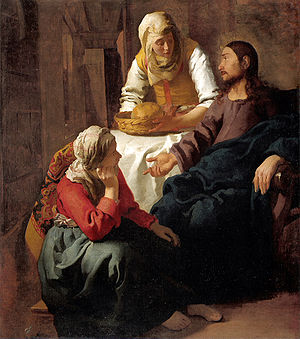
Martha and Mary
 

 It is interesting to note how brothers and sisters in a family can be similar in appearance and be readily identifiable from their parents; yet how they differ! People might express surprise when they find out you are a brother or sister to someone they know well, and suddenly make the connection with you. They might say ‘you are not a bit alike’!

 It is interesting to note how personalities and tastes and temperaments differ under the same roof. How some people can be described as ‘explorers’ (adventurous, wanting to socialize at parties, see the world) and those who are ‘settlers’ (I’d rather stay at home, order a take-out, watch a movie on TV). [They usually marry each other!]

 Comparisons are odious. We hate the phrase as we grow up: ‘why can’t you be more like your brother/sister?’ At school, if you had an older brother or sister, teachers may, intentionally or not, compare you (usually unfairly) with an older sibling, and expect you to measure up to their abilities or achievements. You are not seen for who you are as a unique individual with your own quirks. You may feel constricted, in a strait-jacket by this measure.

All our lives we will be compared one way or the other. We have to accept that and work on our own uniqueness! One of my favourite books is ‘The temperament God gave you’ and you learn to accept certain things about yourself and other’s points of view or alternative ways of seeing things and acting. People will have to accept us too!

Martha and Mary are presented to us as different contrasting personalities. Martha is the active, about -the-house type, expresses her opinions readily, complains, sees all that there has to be done and stresses about it. Mary is silent, recollected, seemingly passive, a listener. Martha complains that Mary should be helping. Jesus rather, praises Mary for getting her priorities right, for ‘choosing the better part’. Martha, it seems, had lost sight of the bigger picture. She focused more on the WHAT of life than the WHY. Martha had lists of things to be done and would mentally cross them off, Mary had one thing on her mind: ‘today the Lord and Master is coming to visit; I will listen and learn and keep Him company’. Whereas Martha was concerned about short-term soon-to-forgotten priorities and jobs to fill her day, Mary achieved more because she has her eternal end in sight and acted on that perspective.

I have always had one difficulty with this story though. It seems unfair! Martha was trying to do her best after all! I remember growing up that if guests came to visit, that we would all be expected to help out in the kitchen to get things ready or set the table or clean around the house. We would be quickly reminded to help out and to do our share of the work if we were seen to be slacking.

 
Maybe the problem though is that Martha did not know when to stop. The unique opportunity of having Jesus as her guest was lost sight of. She kept on working and would lose the meaning of the present moment. How often we lose sight of what we are doing at a given moment because we are too focused on ‘what’s next’? We need more recollection and repose, like Mary, who chose the better part’.

We need more interior life.


Fifteenth Sunday of the Year


The Good Samaritan


In recent weeks and days we have seen the importance of decision making, the pain and the torture and the sleepless nights some people in our Government and backbenches have experienced in coming to a final decision, a decision that will affect countless thousands of women and their unborn children in the years to come.

I do not wish to dwell on the outcome of this week. That is for another day. But some of what follows could be applied now to how we address the topic of the unborn from now on.

What the readings for the Gospel tells us is the importance of coming to the right decision and the part that flawed reasoning takes that we can infer from the Levite and the priest on their way to worship.

As we might reflect on the decisions of various public representatives, it is strangely appropriate that the parable presented to us today is in fact about coming to a right way of thinking and acting out of that conviction.

The stained glass window on the left hand side of the cathedral or the north side, three windows down, shows clearly in summary the Good Samaritan and behind him one turning to the left and the other to the right, the priest and the Levite going their separate ways.

The two baddies in the story were those who purportedly worshipped God and were on their way to do so and as we know so well, ignored the pressing urgent need before them that should have taken priority. Their reasoning was based on human regulations of what was clean and unclean. They categorised the person before them and turned away.

Their false sense of what was right, their narrow focus on uncleanness and thereby were losing sight of the God they worshipped. They made a deliberate decision by their body language and movement – no words of theirs are recorded. Theirs was silent inaction and avoidance of what and who was put before them. The poor person who was violated has his dignity violated again by two acts of deliberate avoidance. The Levite and priest are so heavenly-minded that they are of no earthly use. They have also sinned against themselves as well as giving dishonour to the esteem others have accorded to their chosen profession /way of life. It must have been quite shocking to Jesus’ hearers that He would have used the analogy without of course naming and shaming any named individual or group before him.

In the course of our day, certain unexpected situations will crop up – each challenging us to react and decide, a phone call and the caller ID makes us decide whether we are going to bother, the neighbour or fellow parishioner who hasn’t spotted the fact that we have seen them first and we dive into a shop or cross the road rather than face a tedious and time consuming conversation, someone we want to avoid, in a coffee shop or restaurant, we don’t want to be caught. Where we sit in a train or a bus or an airplane, glad to avoid discomfort and avoiding someone we find boring or a pain to listen to! Even, dare I say it, where we sit in church in order not to be seen by others!? We can all think of a person who might take up our valuable time and who never usually show any real interest in us, who are better at talking than listening.

We are glad we avoided them and saved ourselves a tedious situation

And how much they might actually need someone to talk to and we have left the opportunity pass us by?

We might purposely avoid that street corner or bridge in the city where a beggar with a cup might be perched.

It can be hard when people we know deliberately ignore us.  And we are all guilty of avoiding others. But rather than dwelling on my hurt, have I done the same thing, where the first person to nab me as it were keeps me from meeting the people I would prefer to meet?

I suppose we have to allow everyone a bad day now and again and make allowances but we can really hurt people by ignoring them – adding insult to injury to the poor man was beaten up in the story was passed by and who could, we imagine, perhaps hear the footsteps of potential help fade away in the distance.

Finally, it is also a case of procrastinating. Maybe the priest and Levite decided to wait and return. Who knows? After all it is only a story but we are delving in to their motives, because we can see times when we delayed to act. The Samaritan did what he could, and did return a second time. His mercy was not a one off, but a way of life.

Would it not be an indictment if we thought that there were people in our lives awaiting a visit, a phone call, or who need an end to our silent treatment, an end to a dispute and an argument and we are the ones holding back from forgiveness and reconciliation with them, even though we think they deserve our coldness?
 

The simple lessons of today therefore are

1.    Our neighbour is not far away at all


2.    The three ways we fail to live up to what the parable teaches us, i.e., in how we fail in relation to our neighbour (both born and unborn) are 

A.    Silence

B.    Avoidance

C.    Delay


3.    Knowing we can’t do it all but that we can do what is within our grasp

The question asked at the beginning of the Gospel today was:
(the emphasis is on doing)
 
'what must I do to inherit eternal life?'

The answer in the words of Jesus in the Gospel is : 'Go and do likewise'

Or as in the commercial for the sports gear: 'Just do it'

Fourteenth Sunday of the Year


At this time of year, if we can afford to get away, go on holidays and the anticipation of travel fill us with a renewed excitement. We get down our baggage and start packing our suitcases, but are now ever vigilant and aware of weight restrictions.

The disciples in today’s Gospel were on a trial run on their first journey away as it were before they would be sent after Pentecost with the Holy Spirit and with the anointing to forgive sins to baptise and to preach.

Funnily enough the disciples are called to go forth without any spare ‘anything’! Why is this? This ensures a speedy and unhindered visitation and area cover in the shortest time possible. The Lord will provide through receptive and hospitable hearers on the first mission of the disciples. And the disciples return comparing notes and stories at the wonderful signs that accompany the message and the preliminary mission.

There must be in all of us at all times that message and that confidence and trust that the Lord is ahead of us in all things and our pilgrimage journey in this life. He knows what lies ahead and He will provide for us. Wherever life brings us, He will be there waiting as well as with us every step of the way. We are therefore to practice detachment form things that can hinder effective witness.

But there is another kind of baggage we carry, and the term ‘emotional baggage’ is used for a person with mental or emotional problems. Often a term that is employed of a disturbed person, often dismissively, is that ‘they have issues’.

Who does not have issues today? Just under the surface there is in all of us baggage we carry, the things that weigh us down, the heaviness in our hearts, the stresses and strains of life, the financial burdens of so many people, the uncertainties of life, the failure of our elected representatives to truly represent us in areas of pressing concern, the cynicism in the media, the relentless doom and gloom in the economy, and daily we are drawn to the blaring headlines of crashes and disasters and terrorism and other acts of violence. There is so much lack of hope in people’s hearts, not knowing where to turn to for relief, solace or comfort. What can explain the depression in young people, taking the ultimate dreaded step? There is in society the lack of a hopeful vision of a clear and consistent moral as well as spiritual leadership.

But any desired change in the world at large, or in society begins with the individual decision-making process.  Rather than be trapped in an ever downward spiral, we must turn to Christ and form a relationship with Him in prayerful trust.

We must recognise the baggage and weight we carry in our hearts. The Bible refers to the burden that sin is, which with anger, shame, self-loathing and guilt can be overwhelming. The burden of sin, and forgiveness is described in the psalms as follows: ‘too much for us our offences but you wipe them away’ (Psalm 44)

He took away our offences for us

“Come now, let us reason together,” says the LORD. “Though your sins are like scarlet, they shall be as white as snow; though they are red as crimson, they shall be like wool” – Isaiah 1:18

 The Lord has lifted us up, by lifting Himself up on the Cross.

‘Come to me, all you that labour, and are burdened, and I will refresh you.’  (Mt 11:28)

We cannot give what we do not have. Pope John Paul – soon to be saint – said that ‘those who have had a genuine encounter with Christ cannot keep it to themselves.’ That is our experience too.

 ‘Blessed be the Lord our God who has helped us and we too are called to help one another in their time of need. Just as we share in God’ consolations, so we share in God’s great help.  (2 Cor 1:4).

To sum up therefore we are called to ‘love one another as I have loved you’ (John). This love means that we should ‘bear one another’s burdens, not as a duty but gladly’. (1 Th 5:14). The fact that we are unburdened (of sin in Confession) becomes a source of joy – the joy of knowing and experiencing Christ’s ready forgiveness most of all, and therefore we are called to forgive as well as be forgiven. This is the greatest challenge of the call to love one another- to forgive one another in Christ. That is truly ‘bearing one another’s burdens.
In effect the disciples were called to carry no baggage in order to more effectively relieve people of theirs!
Let there be no baggage between us or overhead!